Book Fox put together a great list of top Flash Fiction websites organized by the amount of traffic each website receives a month.
These websites are open to receiving flash fiction, sudden fiction, micro fiction, short-short — i.e. stories under 1000 words. These are stories that can be read in 5 minutes or less.
Here are some of the top sites on the list by the numbers:
The Authors Guild’s Open Letter to Generative AI Leaders calls on the CEOs of OpenAI, Alphabet, Meta, Stability AI, and IBM to obtain consent, credit, and fairly compensate writers for the use of copyrighted materials in training AI.
Join more than 8,000 writers—including Jennifer Egan, Nora Roberts, Jodi Picoult, Louise Erdrich, Michael Chabon, Suzanne Collins, Margaret Atwood, Viet Thanh Nguyen, and more—in signing this important letter.
I just read a helpful article From NY Book Editors about some fundamentals for turning your self-publishing into a full-time job. This is not a guarantee or a get rich scheme, but they just cover a couple of basics that all aspiring self-published authors should know:
Treat it as seriously as a full-time job, not a hobby
There are certain things that can turn me into the Orange Jacket Meme Guy/Drake within 5 seconds of seeing a book. Here is the list.
Bad/Mediocre Cover Art: You know what they say, “You can judge a book by its cover.” Trying to save money by making a cover yourself (if you are not a professional artist) is a bad idea. Having a friend make a cover for you is also an equally bad idea. And even if you are a professional artist, it still may be better to have someone else make your cover, as it is hard to be objective about your own artwork. Since the cover is going to be a key thing that sells the book, it’s worth every penny. Even a mediocre or okay cover will not cut it. You need to have a top quality product. Quality art says, “I put time and effort into this.” Otherwise, why should I spend my time and money on something that is not a quality product when there are millions of other books available?
A book cover can cost anywhere from $10-$950. However, the good news is that I have seen decent covers available for anywhere between $80-$250. One way to save money while still getting a quality product is to buy a pre-made rather than custom cover. At the following Facebook page, you can buy quality pre-made covers for around $80. Book Cover Gallery – A Place for Authors and Artists
Bad Summary: After looking at the cover, the very next thing I’m going to look at is your book’s summary (the blurb that is usually on the back cover). A book summary should have at least 1-2 paragraphs. These paragraphs need to tell the reader the following: What is the hook (What is it about this book that will draw the reader into the story)? Who is your protagonist? What is their goal? What are their struggles to reach that goal? What are the stakes? What is a short, summarized explanation of the plot? Tell us about the unique world or situation they are dealing with that makes this different from other books. Read the summaries of popular books to get an understanding of what you should do.
I’ve seen too many self-published books where there are only about 1-2 sentences giving me a vague description like, “This is my book of poems.” Okay, why should I care? Or, “Experience a summer of romance where Bob meets two charming dudes who sweep him off his feet.” Why do I care about Bob or these random dudes? And why should I spend money to see what happens to them? The other problem is writing a summary that is too long. If you can’t summarize your story in under a minute, there’s a good chance that you don’t know the key points of your own story.
Another deal breaker for me in the summary is overdone plots: vampire romance, YA dystopia, and zombies.
Off putting topics: The other day I read a blurb for a self-published book that casually mentioned child torture. That was enough to make me not buy the book. Other hot potato topics are rape, trauma, or anything that relates to cruelty toward animals and children. These topics must be handled with caution if you should decide to mention them.
No Reviews: I’m less inclined to buy a book that has no reviews whatsoever. Definitely beg, bribe, hypnotize, or do whatever you must to get your family and friends to review the book. That will definitely increase the chances of you making a sale.
Grammatical/Spelling Mistakes Within the First Five Pages: With many books, you can read a short sample before you make a purchase. If I see simple mistakes of spelling, punctuation, or grammar in the first five pages, I will definitely not buy this book. What this shows me is that the author couldn’t even be bothered to use a simple spell-check tool. Paying for an editor to review your book is another important investment as a self-published author. Yet it can be expensive, anywhere from $1000-$10,000. However, if you can’t afford an editor, at least pay for a program like grammarly, which will catch most of the basic mistakes for you. This will cost around $144 a year. Yes, it sucks to spend money, but you have to spend money to make money. Few people are going to buy a book with basic grammar errors on the first page.
Bad Writing in the First Five Pages: Of course, writing is a very subjective art. But in terms of the basics I would stay away from, here is a short list:
Cliches such as starting the book with a character waking up and describing their typical day, or the character looking in the mirror.
Nothing happens. It’s just happy people doing happy things.
Too much description about something that is not important.
Too little description. I am not grounded in the world and I have no idea what is happening.
Sexist writing that objectifies women. I get that your male character is attracted to women, but starting out the story with a gratuitous description of her breasts and butt (when this is not erotica) will lose my interest (Yes, I’ve put down books for this reason). And given that 70% of people who buy books are women, this may not be the way to start out.
Too many characters. In many self-published books I’ve bought, I’ve seen the mistake where the author feels a need to introduce all their key characters in the first chapter. Having ten random new people all thrown at me simultaneously makes my head feel like it’s spinning. Try not to introduce the reader to too many people at once.
I would definitely recommend that you pay for a developmental editor if you can afford it. And if not, at least get a friend to read your book and give you feedback before you publish. Also, I would recommend that you join a writers group. A writers group has immense value for developing your skills as a writer and getting free feedback.
I hope this was helpful. Feel free to comment. Now go publish the best book you can!
Disclaimer: I am not an expert on these agents or who they represent. I am merely passing along information. Make sure to do your research and due diligence.
Until the 1960s, Venus was thought to be a potential location for human colonies and space exploration because it was known that there were clouds on Venus, so there was some speculation that it could have an environment that was similar to Earth. Indeed early pulp science fiction (particularly between the 1930s-1950s) depicted Venus as a lush paradise full of jungles, oceans, swampland, Amazonian warrior women, and even dinosaurs.
It was only in the 1960s, when scientists got a better look, that it was discovered that Venus was super hot and that the clouds are made out of sulfuric acid.
Another problem is that Venus has more volcanoes than any planet in the solar system.
Currently now, much of the discussion of finding another planet for humans to live on focuses on Mars, not Venus. Yet surprisingly, there are many aspects of Venus that could make it a better candidate than Mars, despite Venus being a boiling hot oven of sulfuric acid. So some people are now saying that the original assumption popular before the 1960s was correct. One of the people who has argued that Venus is a better candidate for human colonization than Mars is Geoffrey A. Landis, a NASA researcher who has written much on this topic.
The benefits of Venus are its mass is 82% of Earth’s, and its surface gravity is 90% of Earth’s.
Because of the thick atmosphere, people wouldn’t need a heavy pressure suit, just a simple acid-resistant suit.
Mars, by contrast, has low atmospheric pressure, low temperatures, low gravity, and high exposure to cosmic radiation.
People would not be able to live on the surface of Venus (at least not in its current form). The surface is 900 degrees Fahrenheit (475 degrees Celsius), which means it is hot enough to boil lead.
However, the higher up you get from the surface, the thinner and cooler the atmosphere gets. There’s a sweet spot about 50-55 kilometers up where the atmosphere is down to about normal Earth pressure, and temperatures are similar to the Mediterranean.
As Geoffrey A. Landis says, the surface is hell, but at cloud level, it’s paradise.
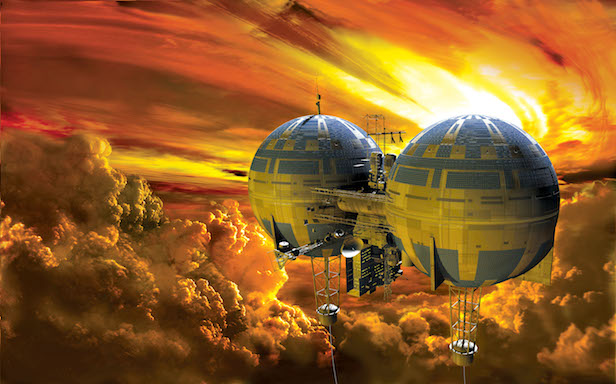
So a possibility is to build floating cities 50-55 kilometers above the ground. But how would one do this?
Venus’s atmosphere may be a vital asset in this endeavor. Venus has an incredibly thick atmosphere, about 100 times that of Earth. Most of the atmosphere is carbon dioxide, with just over 3% being nitrogen, and only trace amounts of other gases. And yet Venus has more nitrogen than Earth, simply because it has so much atmosphere.
There is also a sea of carbon dioxide down on the surface, having characteristics of both a liquid and a gas, which will be important for terraforming the planet, but we’ll get to that later.
Now with regards to the carbon dioxide atmosphere, we must keep in mind that carbon dioxide has a molecular weight of 44, which means that any gas with a lower molecular weight than carbon dioxide can act as a lifting gas, much like helium in balloons on Earth. That means that hydrogen and helium work even better as a lifting gas on Venus than on Earth, but it also means that our normal oxygen-nitrogen air mix could actually make a balloon float on Venus. And you can get hydrogen, oxygen and water out of the sulfuric acid that makes up the clouds.
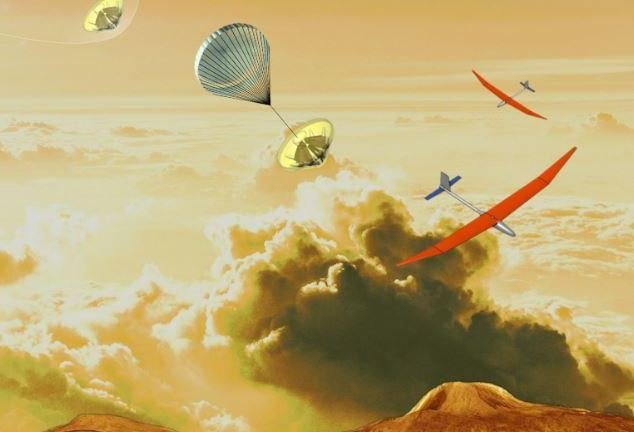
A near-term option for humanity would be to have automated aerostat vehicles in the atmosphere.
But for longer-term habitation, Venus’s colonists could make large, sturdy blimps with the mass manufacture of graphene. What is graphene you may ask? Graphene is the building block of graphite (which is currently used in pencils). This wonder material graphene is the thinnest material known to man, at one atom thick. And yet it is incredibly strong, 200 times stronger than steel. Graphene is also an excellent conductor of heat, electricity and has interesting light absorption properties. Graphene is an exciting material that is getting a lot of attention—especially since the 2010 Nobel prize in physics went to Andre Geim and Konstantin Novoselov, who first isolated Graphene in 2004.
And there is plenty of carbon for making graphene in Venus’s atmosphere. Venus’s colonists could use the carbon to make diamond hard tethers anchoring their blimp cities to the ground. These hard tethers could be possibly strong enough to survive the super-hot, acidic hurricane below. Or the colonists could use them like harpoons with a winch to drag their settlements around like a giant octopus.
Another benefit of Venus, Geoffrey A. Landis points out, is that the super thick atmosphere could provide shielding from cosmic radiation.
Up higher in Venus’s atmosphere, the lighting is a lot like Earth, except that if one stays in the same spot, they’ll have a day-night cycle not of 24 hours but of 243 days. Since the day-night terminator creeps along at a fast walking pace, even at the equator, a colonist could opt to stay in perpetual sunlight, making it handy for solar power or growing plants to help recycle air and water, and to extend food supplies.
In fact, solar arrays can produce just as much energy pointing downward toward the reflective clouds as they can produce by pointing toward the sun.
There is also a superabundance of solar energy to power engines. And all the wind allows colonists to use wings to provide lift for a plane or a kite, not just balloons and buoyancy. So, there are a lot of options for transportation and moving around in the clouds.
The abundance of atmospheric carbon dioxide and nitrogen will also be a useful resource for greenhouses.
The creation of mining robots could allow people in these sky cities to have autonomous sources of production that could give them a good deal of free time for recreation, education, family life, and spiritual reflection.
Venus also has a surface area 3.1 times the land area of Earth. With all this room, a billion habitats, each one with a population of hundreds of humans, could be placed in Venus’s atmosphere.
Floating cities would have their obstacles. Floating cities on Venus would have to be very thin and very lightweight to float. The colonists could also just orbit the planet in conventional rotating habitats. Yet being lower in the atmosphere would protect from meteors and radiation. Geoffrey A. Landis says the thick atmosphere would protect from radiation. But if this is not enough, the colonists could also put their blimps in water shielding to add some protection.
Venus’s surface is way too hot for humans to mine on their own. But they could control mining robots from up in their floating habitats and deliver the goods by going up a tether in the form of a high-temperature fullerine tether. Or the robots could pop compressed gas cartridges to fill balloons and float back up.
A settlement could float over a spot they are mining.
TERRAFORMING VENUS
Terraforming Venus is another option. And given Venus’s mass and gravity, it may be the best candidate for terraforming in the solar system.
Terraforming could be accomplished by constructing a dome or an enclosure on the planet, which would grow to encompass most of the planet’s usable area. This could be part of the process of cooling down Venus.
Part of the reason Venus is so hot is its thick atmosphere. But a major reason for the heat is Venus’s proximity to the sun. If one blocks out the light between Venus and the sun, they could reduce that heat. Colonists could use massive shades that are about as big as a football field but don’t weigh too much. Ideally, they would want to use something very light and strong, like graphene made of carbon. The colonists could manufacture these graphene shades on the cloud cities of Venus and deploy them to the Lagrange point between the sun and Venus by the millions until they shade Venus’s atmosphere. The atmosphere would then begin to cool. The thick atmosphere would start to liquefy and turn into seas of carbon dioxide.
The floating cities would probably not survive the process of liquefying the atmosphere, so the colonists would have to abandon them and retreat to orbital colonies. Or they could modify the floating cities to safely survive the process (like some Johnny Quest car blimp?) and be able to land on the seas of carbon dioxide and survive the changeover of early terraforming. During cooling, there would be a ton of earthquakes and maybe volcanic activity while it snows dry ice. And then, the colonists would have to find a way to export or permanently sequester all that carbon dioxide so they could warm the planet to an Earth-like temperature and an atmospheric composition.
Another possibility for clearing the atmosphere of Venus would be to use solar mirrors instead of shades. This would heat the planet even more and evaporate the atmosphere away.
But if the colonists went with the strategy of cooling the planet, they could keep cooling it until the seas of carbon dioxide froze and turned into surfaces of dry ice. Then they could pave over that and introduce dirt and water.
The trouble is, how to get enough water for oceans?
There is a large amount of water available in Venus’s atmosphere. But it isn’t enough for real oceans. It’s enough for people to drink and to farm food inside greenhouses. But it’s not enough to make a classic biosphere. For that, the colonists would need to come up with somewhere between 10-100 billion megatons of hydrogen.
One possibility is to boil hydrogen off the sun since the sun is a massive source of hydrogen.
Another possibility is to import the hydrogen from Jupiter or Saturn.
However, when it comes to making Venus more Earth-like, there is also the problem with Venus’s day length. Venus’s day is longer than its year. The sun would rise in the sky and stay there for months before setting for more months.
There are three approaches to this:
First, ignore it and adapt to life on a planet like this.
Second, place mirrors in orbit around Venus to bounce light down on the night side and block incoming sunlight on the day side to simulate a 24-hour day cycle.
Thirdly, the colonists could also make a fake sun with lots of mirrors to bounce light to something about the same angular size in the sky as the sun in Earth’s sky. All the mirrors and shades could also protect Venus from radiation. Though colonists would still want to consider an artificial magnetosphere to hold the atmosphere in. They can’t expect the atmosphere to stick around on its own once they make Venus earth-like.
The other alternative is to go all in and adjust Venus’s rotational speed to a 24-hour day, or maybe save some energy and let people sleep in longer with a 26-hour day. Yet the colonists would need massive amounts of energy to change the rotation of a planet. They would need 10^29 joules of rotational energy to do this. To put that in perspective, it’s more than a billion times the amount of electricity 21st century Earth uses each year. It’s also only a few years of energy output from the sun. (Though it would take roughly the same amount of energy to ship in enough hydrogen to create an ocean.)
Accomplishing this task could come in the form of sending a large beam of hydrogen from the sun like a water jet, hitting one side of the planet Venus, injecting hydrogen and spin. If we were getting the hydrogen from gas giants instead, each of those ships and pods would be moving quite fast, carrying a large amount of kinetic energy. The amount of kinetic energy needed for massive transports of hydrogen would be in the same ballpark as rotational energy. So the colonists would need to figure out how much hydrogen they want and how much rotational energy they need and make sure each pod of hydrogen is moving at a speed to deliver that energy. If that were moving too fast, they might ship in comets or massive balls of ice and let the extra mass carry the extra kinetic energy. It would still be very tricky to get this process to work. But a benefit of this is that if the planet is spinning fast enough, it could generate a magnetosphere, so the colonists wouldn’t have to generate an artificial one.
Another possibility is to give Venus a moon and use it as a gravity tractor to impart spin. And the outer planets of our solar system have an abundance of moons, along with excess hydrogen. The colonists could also take the excess carbon from Venus and build a fake moon.
While these are all interesting ideas, the reality is that terraforming Venus would most likely take thousands of years. So this would involve a long-term commitment that would outlast the length of many civilizations. The kind of society willing to do this would either have to be very dedicated, or they might be some form of artificial intelligence with a lengthy lifespan.
The residents of Venus have a few options: The orbital colony route, the floating city route, the para-terraforming route where they use shades to cool the planet down and use orbital mirrors to create a 24-hour day, or go big and start spinning the planet up to a 24-hour day by importing shipments of hydrogen or water to impart that spin momentum.
The colonists also don’t only have to do one option. They could have several phases or multiple options pursued simultaneously.
Carbon in the form of graphene will likely be the preferred building material of the future, so Venus could export gigatons of that.
For export, Venus has lots of carbon dioxide, nitrogen, and solar or wind energy for industrial processes. They could also build solar-powered satellites for export, along with shades and mirrors for terraforming.
Mining the surface (which is primarily a basaltic silicate), will provide silicon, iron, aluminum, magnesium, calcium, potassium, and sodium.
Venus could give Mars pods of nitrogen for their terraforming process, which could get shipped to their atmosphere and shot down. Metal for the pods would come from mining the surface of Venus.
Venus is closer to Earth than Mars. With current propulsion systems, launch windows to Venus occur every 584 days, compared to the 780 days for Mars. Flight time is also somewhat shorter; the Venus Express probe that arrived at Venus in April 2006 spent slightly over five months en route, compared to nearly six months for Mars Express. This is because at closest approach, Venus is 40 million km (25 million mi) from Earth (approximated by perihelion of Earth minus aphelion of Venus) compared to 55 million km (34 million mi) for Mars (approximated by perihelion of Mars minus aphelion of Earth) making Venus the closest planet to Earth.
Then there is the accessibility of asteroids from Venus. In terms of flight time, Venus is closer to the Asteroid Belt than either Earth or Mars. Geoffrey A. Landis argues that the higher orbital velocity of Venus makes transfer orbits somewhat faster and increases the number of transfer opportunities to various asteroids in the Asteroid Belt.
There is also the possibility of tourism on Venus. The appeal is that people can walk around beautiful sky cities without a heavy pressure suit. And with the thick atmosphere, there is the possibility of hang gliding with just a mask and a thin acid proof suit.
As mentioned at the top of this article, Venus was a popular planet in early science fiction before it was known that the surface was hot enough to melt lead. Therefore, there are quite a few examples of humans colonizing Venus, especially in the age of early pulp Science Fiction. But be aware that these examples do not offer accuracy given what we know about Venus today. I mean…especially not with the dinosaurs and Amazonian warriors and so on.
In the early pulp science fiction of the mid twentieth century, there was a lack of agreed upon canon about what Venus was like, given that the stories about life on the planet included everything from thick jungles, to a water world covered in oceans, to widespread deserts. In comparison, the writing about Mars was much more uniform.
Science fiction scholar Gary Westfahl attributes the disparity largely to the image of Mars made popular by Percival Lowell around the beginning of the 20th century. By contrast, very little was known of Venus aside from the fact it had clouds.
Disclaimer: I produced a list below of examples of Venus in science fiction. This list below doesn’t represent all instances of Venus in science fiction, as there are multiple instances. The list simply represents a few examples I have chosen to highlight.
A True Story by Lucian of Samosata – 2nd Century A.D. (One of the earliest known examples of interplanetary travel in fiction. Lucian refers to Venus as the ‘morning star.’)
Voyage à Vénus by Achille Eyraud 1865 (One of the earliest known uses of Venus as the primary setting in fiction)
Last And First Men by Olaf Stapledon -1930 (A book that discusses genetic engineering for interplanetary colonization.)
“The Big Rain” by Poul Anderson – 1954 (Anderson writes about terraforming Venus’s atmosphere.)
Perelandra by C. S. Lewis – 1943 (This is a retelling of the story of Adam and Eve in the Garden of Eden on floating islands in a vast Venusian ocean.)
2312 by Kim Stanley Robinson – 2012 (A very well written novel showing human colonization on multiple worlds in our solar system.)
“The Sultan of the Clouds” by Geoffrey A. Landis in Asimov Magazine – 2011 (I highly recommend this story for anyone who wants a more scientifically sound depiction of what life on Venus could look like. This is written by a NASA researcher.)
The Snows of Venus by G. David Nordley in Analog magazine – 1991 (In this story, G. David Nordley suggests that Venus might be spun-up to a day-length of 30 Earth days by exporting its atmosphere of Venus via mass drivers.
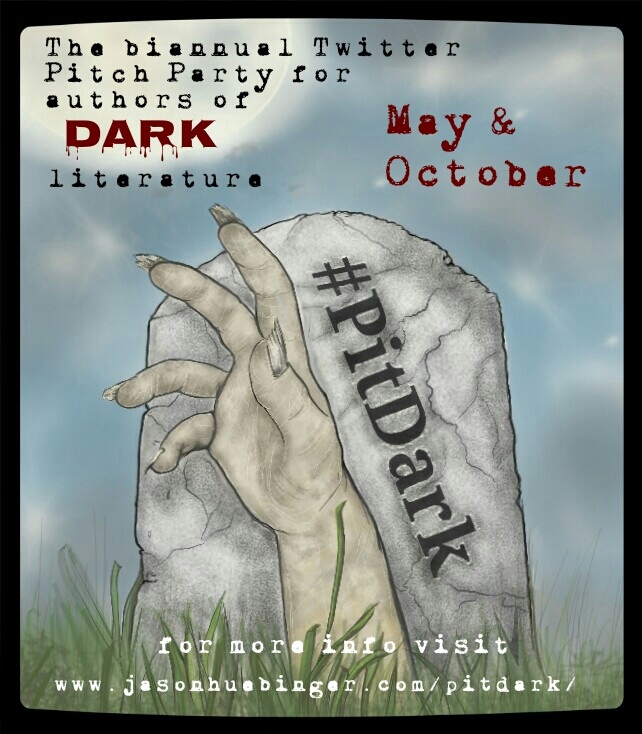
The next #PitDark will take place on May 25, 2023.
This is an event for literature of a darker nature.
The contest will happen on Twitter under a common hashtag (#PitDark). During a 12-hour window on the chosen day, authors with completed manuscripts who are seeking representation or publication can tweet a pitch for their books (at most, once per hour).
Agents and publishers will make requests by marking pitches as a like on Twitter. If your tweet is liked, please follow the agent or publisher’s submission guidelines.
In an unnamed central European country after the Great War, a humble fishmonger gets caught up in a world of espionage and intrigue when he answers the wrong phone call.
This thriller meets absurd comedy of errors is currently on Apple Book’s Best Books of May list. They call it “the most fun spy thriller we’ve read in ages.” And Publishers Weekly calls it “a stellar debut.”
I had the pleasure of discussing this novel with the author himself and have included our chat below. Not only did we talk about the book, but we also discussed the process of writing and publishing with an independent publisher.
Jessica: What inspired you to write Citizen Orlov?
Jonathan: I caught COVID-19 and had some weird fever dreams. In one dream, I was back in my government days and they sent me on an assignment to a strange, foreign country. Somehow I managed to get there without knowing where I was. Anything is possible in dreams, of course. As soon as I arrived, someone started shooting at me. I remember a sense of indignation about this. I was only following orders. Who was trying to kill me and why? In the morning, I wrote down the dream and it became the kernel of CITIZEN ORLOV.
Jessica: What is your process as a writer? When do you find time to write? How long did it take you to write the novel? What was your editing process like?
Jonathan: I’m not an x-words-every-single-day sort of writer. I do a lot of pondering and planning before I get into drafting. On my masters course they called this pre-writing. I like that concept. Once I get into the first draft, then I write every day, but I need to know where I’m going first. CITIZEN ORLOV began life as a novella, but my writing group encouraged me to expand it into a novel. So, the writing process was a little on and off, over about a year.
I was nervous about the editing process because I thought: what if my editor doesn’t ‘get it’? What if they don’t understand what I’m trying to do? Luckily, my editor, Elana Gibson, absolutely got it. It was clear to me in our first meeting that she understood what I was going for and could help me get there. On that first call we spent ages talking about Wes Anderson and Coen Brothers movies and I immediately relaxed. After that, the process was a pleasure. Elana had some great ideas for drawing out and clarifying the themes and tone of the story.
Jessica: Describe the experience of publishing a book through an independent publisher. What made you decide to go indie? How do you think the process might have been different than publishing with one of the big 5 publishers?
Jonathan: I started out pitching agents for a few months but I was getting no feedback aside from some rote rejections. I still don’t know if any of those agents read a single word of my work versus my query letter. So, I switched to pitching small presses and got an offer almost immediately from CamCat Books, an independent publisher based in Nashville, TN.
I was drawn to CamCat because their submission process was way more onerous than most; it was like an exam. I really liked that because I thought: at last, there’s a chance someone is actually going to read my stuff. They loved it and made me an offer. It was an easy decision, because they were so enthusiastic about the novel.
This is my debut novel, so I don’t really know how to compare my experience with the Big 5 process. Of course if you go via an agent there’s an extra step where the book is out on submission. I imagine the editing process is similar, but the marketing process is probably different, given that the Big 5 have bigger budgets.
Jessica: What were some of your favorite moments?
Jonathan: Honestly, the process has mostly been a pleasure. I’m learning new things about publishing every day. Although CamCat is a small team, they have a ton of experience in publishing and so it’s been like a crash course for me in how the industry works.
Jessica: What have been some of your challenges in this process?
Jonathan: One of the most nerve-wracking moments was when they sent me five cover concepts and asked me to make detailed comments about them. I’m not really a visual person, but luckily I’m married to a professional artist and former graphic designer, so I asked my wife to take a look and that was a big help. The concepts were all so different and it felt like a big decision.
Jessica: What was the marketing process like for your book?
Jonathan: Well, the marketing process is still ongoing. I’ve been working with CamCat’s marketing team and also an external publicist. I think the most important part of that process has been the team sending the book out for reviews, which mostly hasn’t involved me as the author. My inputs have been doing interviews with magazines and in some cases writing articles about the books that have influenced my work, and so on.
My publicist is going to continue working with me for about a month after publication, and we’re expecting reviews to keep coming in over that period.
I’m also looking forward to attending ThrillerFest in NYC for the first time. I’m in the International Thriller Writers debut authors program, which means I’ll get the chance to pitch my book to the whole conference, just a week after it’s published.
Jessica: What did you learn in this process of publishing your first book?
Jonathan: The biggest single lesson I’ve learned so far is that publishing a book is a team sport. Writing often feels solitary, but publishing is definitely not. I can’t count the number of people who’ve had a hand in bringing CITIZEN ORLOV to the market, but the process has involved lawyers, finance folks, editors, designers, marketeers, a production coordinator, a publicist, a printing company and a distribution company, as well as reviewers, and the bookstore that’s agreed to host the launch event.
Jessica: What advice would you give other people looking to publish a book?
Jonathan: For those looking to get traditionally published, my advice is: make your work stand out. Find ways to make your work different. And, of course, make sure the quality is good enough to publish. From what I’ve seen so far, it seems that everyone in the publishing industry is awash with manuscripts. No surprise there. So, there’s not much point in pitching work that’s not ready for prime time or—dare I say it—work that’s boring. Publishing folks are run off their feet. Send them something that will stop them in their tracks and make them take notice.
Jessica: Thanks for your time, Jonathan Payne! I highly appreciate your deep dive into the process of publishing with an independent publisher.
For the rest of you, be sure to check out CITIZEN ORLOV. It’s a fun novel and a page turner to be sure.
It is available for pre-order on Amazon right now, and will be published May 23rd.











 Stories From Tomorrow - Jessica Brook's Author Site