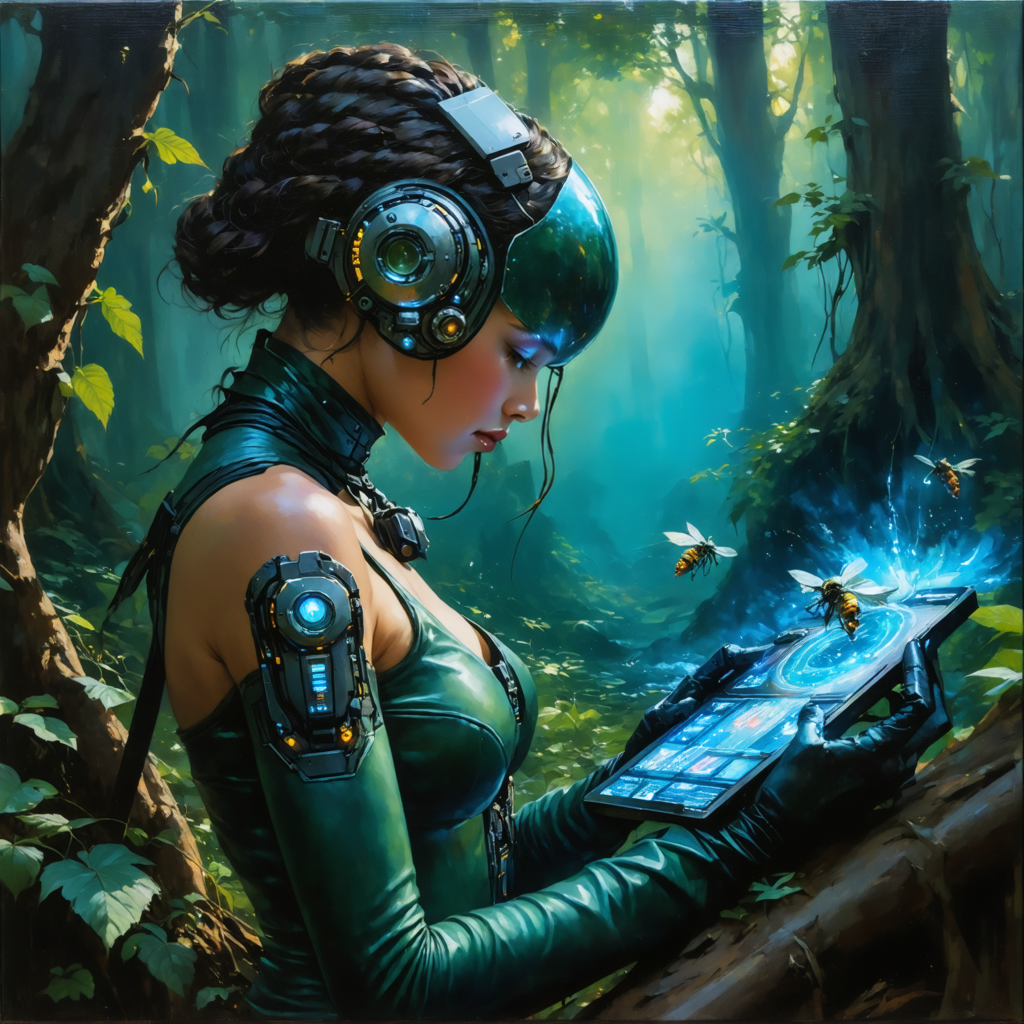
(Image Made with AI at PlaygroundAI)
Right now many writers are freaking out about the advent of AI that can also write fiction.
Yet before you start freaking out too much, remember that technology is amoral. The AI we have right now is not sentient. It’s not Skynet. It’s actually a very simple tool that is as good or bad as the people using it, and as good or bad as the input it gets. So whether it puts people out of a job, or gives them more opportunities, is not dependent on the technology, it’s dependent on us and our choices.
It can become a corporate tool to generate mass amounts of cookie cutter content, or it can give a refugee the ability to tell their story to the world. Maybe it’ll do both.
I am aware there was a controversial article published in the New York Times about an AI that tried to get a journalist to leave his marriage. But if you look closely at the article, you’ll see that the journalist was asking the AI to respond as if it had a Jungian concept of the Shadow. I am sure the AI simply combed the internet for dark ideas, and replied in kind.
Basic Tools AI Can Provide Fiction Authors According to ChatGPT Itself
If you want to know something about someone, the best way is to go and ask them. It’s Journalism 101. When I asked ChatGPT how it can help authors write fiction, it told me the following:
AI can help fiction authors in several ways, including:
Idea generation: AI can be used to generate ideas for stories, characters, and settings. There are various AI-powered tools available that can generate prompts and ideas for authors to build on.
Writing assistance: AI can assist authors in writing by providing suggestions for sentence structures, grammar corrections, and even predicting the next word in a sentence. These tools can help authors improve their writing and catch mistakes they might have missed.
Character development: AI can help authors develop more complex and dynamic characters by providing insights into their motivations and personality traits. There are tools that use machine learning algorithms to analyze large amounts of data to provide personality insights.
Plotting: AI can help authors create more compelling plots by analyzing existing stories and identifying patterns that work well. AI can also help generate story arcs and plot outlines based on a set of criteria.
Translation: AI can help authors reach a wider audience by translating their works into different languages. There are translation tools that use machine learning algorithms to provide accurate translations.
Overall, AI can help fiction authors by providing new ideas, improving their writing, and assisting in character and plot development.
Thanks ChatGPT.
Generating Fiction Content with ChatGPT
I have spent much time messing around with ChatGPT. As someone who makes my living through writing, what do I think about it?
A tool like ChatGPT functions as an aggregator of data and information. It cannot have creative thoughts, wisdom and personal insight like a human being can, but it can comb the data it was given to aggregate the creative thoughts and insights of already existing texts.
Here is more detail about how it works: ChatGPT is a transformer-based neural network that provides answers and data with human writing patterns. The AI has been programmed with endless amounts of text data to understand context, relevancy and how to generate human-like responses to questions. (Entrepreneur.com)
I have asked ChatGPT to write me a few short stories. These stories tend to read like a synopsis rather than a story itself. They don’t go into much depth. Or when they do get into emotional details, they read as very cliche. But it makes sense that the language is cliche, because instead of providing something fresh, it’s making a composite from the existing content of the however many thousand stories it read to generate my request.
I’ll share with you a 500 word story I had ChatGPT write about pirate romance to demonstrate how it works:
As the sun began to set over the vast ocean, the sails of the ship caught the warm, orange glow of the sun, making it look like it was on fire. The crew aboard the ship was made up of rough and tumble pirates, men and women who had spent most of their lives on the open sea. Among them, there was a young woman named Isabella, who had joined the crew to escape her mundane life on land.
Isabella was the youngest and only woman on the ship. She had always been drawn to the sea, and the pirate’s life seemed like an adventure that she couldn’t resist. Her life on the ship was rough, but she loved it nonetheless. The crew, at first, was hesitant to accept her, but as they saw her determination and skill, they began to welcome her as one of their own.
One day, as they were raiding a merchant ship, Isabella was tasked with keeping watch on deck. As she stood there, scanning the horizon, she heard a voice behind her.
“Beautiful night, isn’t it?” The voice belonged to the captain, a rugged and handsome man named Jack.
Isabella turned to face him and was taken aback by his piercing blue eyes and his rugged features. She had seen him around the ship, but they had never spoken before.
“Yes, it is,” she replied, feeling her heart flutter in her chest.
Jack stepped closer to her, and she could feel the warmth of his body. “You know, Isabella, you’re not like the other crew members. You have a spirit and a fire that’s rare to find in someone.”
Isabella’s heart skipped a beat as she heard his words. She had never thought that someone like Jack would pay attention to her. “Thank you,” she replied, her voice barely above a whisper.
They stood there in silence for a moment, watching the stars above them. Isabella couldn’t help but feel drawn to Jack, and she could sense that he felt the same way.
As the night went on, they found themselves stealing glances at each other, their eyes locking for a moment before quickly looking away. They knew that they couldn’t act on their feelings, for fear of the crew finding out and causing trouble.
But as they sailed on, Isabella and Jack found themselves drawn together, unable to resist the magnetic pull between them. They stole moments together when they could, stealing kisses and sharing secrets.
As their ship sailed into the sunset, with Isabella and Jack holding hands on deck, they both knew that their love was forbidden, but they also knew that they couldn’t resist it. They were pirates, after all, living life on their own terms, and they were willing to risk everything for the love that they had found.
It’s not bad for something written by a computer in less than a minute. But it would definitely not be accepted for publication by any quality short story fiction publisher. In addition to part of it reading like a synopsis, there are a lot of cliches, including Captain Jack’s “piercing blue eyes.”
For now, I think the technology will function in conjunction with authors, rather than replacing them. Just like a calculator doesn’t get rid of the need for mathematicians, it has just increased the amount and sophistication of math that is done by mathematicians, while decreasing the grunt work.
The Current Rise of Slush For Publishers
Neil Clarke recently released an article discussing how the number of submitters Clarkesworld magazine has had to ban has escalated to an all time high this year because of people submitting stories written by AI.
When it comes to paid publishers, people are going to be more tempted to just copy paste an AI written story, submit it and see how far they can get.
Publishers may be challenged to think of new ways to prove that the story wasn’t entirely written by AI. Or the process of verifying the writer and building a relationship with them as a person might get more thorough.
My writer friends aren’t going to like this, but another reality is that publishers might become less open to the public. They might develop a team or network of writers they already know in order to decrease slush and output human written content.
Predicting The AI Revolution By What Has Come Before:
If we want to understand the future, we must understand the past.
Ever since the beginning of the Industrial Revolution, we have found ways to use technology to decrease the time it takes to do a task and to rapidly increase output. The thinking at the time was that this would decrease the number of people doing labor. Instead, we’ve seen the very opposite. People now work longer hours than they did before the Industrial Revolution.
When we found a way to use factories to make textiles, this didn’t mean that less people were involved in making textiles. This just meant that the process became much more streamlined, sophisticated, and that the output of textiles dramatically increased.
Also, when the photograph was invented 200 years ago, this didn’t put artists out of work. Instead, this changed the nature of art itself. As the use of photographs became much more prevalent in the beginning of the 20th century, so too did we see the sudden explosion of the modern art movement. Before photographs, art was about capturing the likeness of an image. But as photographs made realism less impressive, art became more about creativity and expression. There is also definitely an art and skill to photography itself.
And during the Information Age, we’ve seen that spell checking, grammar checking and online publishing has also dramatically increased the output of fiction. As a result, the Information Age has dramatically increased the output of books compared to where things were in the Pre-Information Age. The creativity and style of an author is now way more important than their ability to spell check and grammar check their work.
AI Could Function as a Tool to Rapidly Decrease the Time it Takes to Write a Book.
If we learned anything about technology, it’s that it decreases time to do a task, streamlines the process and dramatically increases output.
Right now, it can take an author anywhere from 6-12 months to write a book. And if the author is writing a sci-fi or fantasy novel with a very creative and in depth world, it could take much longer. I myself take 2 years to write a book (but I also do this in addition to having a full time job and other adult responsibilities).
What if an author could feed the AI algorithm a plot synopsis for their book, character descriptions, world building, and have the algorithm generate a 300 page book in an hour? It’s likely the author would still have to go in and provide oversight, get rid of cliches, make the language fresh, add personal flair to the dialogue, and so on.
But still, it’s possible that this technology could dramatically decrease the time it takes an author to do the grunt work of writing a book, maybe decreasing that time from 12 months to 1 or 2 months. What it would be doing is providing the labor of choreographing a fight scene, or describing a setting rather than making the author take the time to do it.
Lessons From James Patterson and His Writer Factory
People are often impressed that James Patterson can publish 14 books a year. This seems especially impressive after I just mentioned the average writer can pump out at most 1 book in that time (if they are lucky). But here’s the thing about James Patterson—he has streamlined the process. He has a whole team of writers available to write his books based on his outlines and feedback. He has other writers available to do the grunt work of the writing, while he is free to provide the creative oversight.
I imagine this would be a similar dynamic when it comes to a person streamlining their own creative process with the use of AI bots.
In the same way that photography made creativity more important in art, perhaps creativity will become more important in the fiction world as well.
AI and Fiction in the Corporate World
When analyzing the nature of our corporate, hyper capitalist, neoliberal world, one possibility is that publishing companies will have an AI that reads 1,000 of the best selling novels, and then churns out some cookie cutter content that is a composite of all those novels. They would still need a person to go through and provide oversight. But it would be one person pumping out a 1 novel in a month, rather than in a year. People like James Patterson who are good at providing creative oversight will become very valuable, grunt work will become less valuable.
A current example of this dynamic is that the author Erik Hoel at Electric Lit fed his novel to an AI, GPT-3, to see if the AI could write something better. He was shocked and horrified when the AI wrote something almost as good. There were some mistakes the AI made and weird descriptions Erik had to go in and fix. But Erik still said the AI wrote a facsimile of his book in 1000x the speed.
The Capability of AI to Democratize Writing
Above I’ve mentioned the corporate capitalist response, but there is another reality as well. Technology could go the other way and help those who historically have not had access to writing their book because of limitations on education or money.
A quarter of the world’s books are written in English even though a quarter of the world’s population does not speak English.
An overwhelming number of authors are white.
Education is also a barrier to many people being able to tell their stories. I’ve heard English as second language speakers be told that they should give up their hopes of writing a book in English, because it just wouldn’t be good enough to be published.
Is a refugee or a homeless person less worthy of telling their story than a college graduate? If anything, the people in the aforementioned group might have a much more interesting story to tell.
Language, education and societal bias could be less of a barrier to people getting their creative ideas out there.
The Personality of the Author May Become More Important
As publishers begin to churn out a tidal wave of books that are all very similar to one another in order to make a profit, people may turn against this by finding an indie author with an authentic voice and a unique personality they find interesting.
Matt Giaro on Medium made a good point that there is a reason people spend more time on social media than Wikipedia. People are more interesting than piles of information, or what he called “steamed broccoli.”
As Our Output Increases, So Will Our Ability to Consume It
As our ability to generate output dramatically increases, I think parallel technological movements will evolve to enhance our ability to consume it. Perhaps this is the cyberpunk writer in me. But if we consider the possibilities inherent in neural nets and brainware, I think we are going to start developing technologies that will rapidly enhance peoples’ ability to read quickly and mentally digest copious amounts of content. A person may able to read one novel a day, instead of one novel a month.
This could fundamentally change the human being, just as the Industrial Age and the Information Age has dramatically changed the human being.
Larger Questions About How AI Will Affect Society
Above I mentioned that technology is amoral. It’s only as good or bad as the people using it.
I think for those of us white collar folk who make our living through writing, this moment in time could give us a little humility, and a little sympathy for our blue collar brethren who had their jobs traded away due to technological trends, globalism, and Neo Liberal economics.
Technology has the capability to build us a post-work utopia where people can indulge in their hobbies all day.
Technology also has the capability of creating a hellscape where we’re all replaced by machines and the .001 percent of richest people let us starve off and die while they enjoy their new free, mechanized laborers.
This new AI writing technology could enable a refugee with a limited grasp of English tell their story to the world.
This new technology could also produce writing factories that pour out the same sounding tripe for the masses.
It’s all about what we as a society prioritize as important.
Conclusions?
This is all heavy stuff. For now, maybe just have fun writing a steamy pirate romance? You could call it, “She Walked the Captain’s Plank,” or “Secrets Below Deck,” or “Passion on the Seven Seas.” Those were my ideas.
Here are some additional suggested titles from ChatGPT
- “The Pirate’s Treasure of Love”
- “Rogue Waves of Passion: A Pirate Romance”
- “Tides of Desire: A Swashbuckling Love Story”
Honestly, I think “Tides of Desire” is the best title here. So, you win, ChatGPT.
By the way, I intentionally showed how I used AI to help me generate content for this article, showing how…for now…AI was a tool that helped my process.
Here’s the remainder of my conversation with ChatGPT:
Me: “Do you think AI will remove the need for human authors of fiction?”
ChatGPT: “While AI has made significant strides in the field of natural language processing and machine learning, it’s unlikely that it will entirely replace human authors of fiction. AI language models can generate texts and even entire stories, but they currently lack the creative thinking, imagination, and emotional depth that humans can bring to storytelling.
Human authors have a unique perspective, and they can convey experiences and emotions in a way that AI language models cannot. While AI can assist in the writing process and provide new insights and ideas, it’s unlikely that it will entirely replace the role of human authors. In fact, some experts argue that AI may enhance the creative process, providing new tools and techniques for human authors to explore and experiment with.
In summary, AI language models may have a role in assisting authors and enhancing the creative process, but they’re unlikely to entirely replace human authors of fiction.”
































































 Stories From Tomorrow - Jessica Brook's Author Site