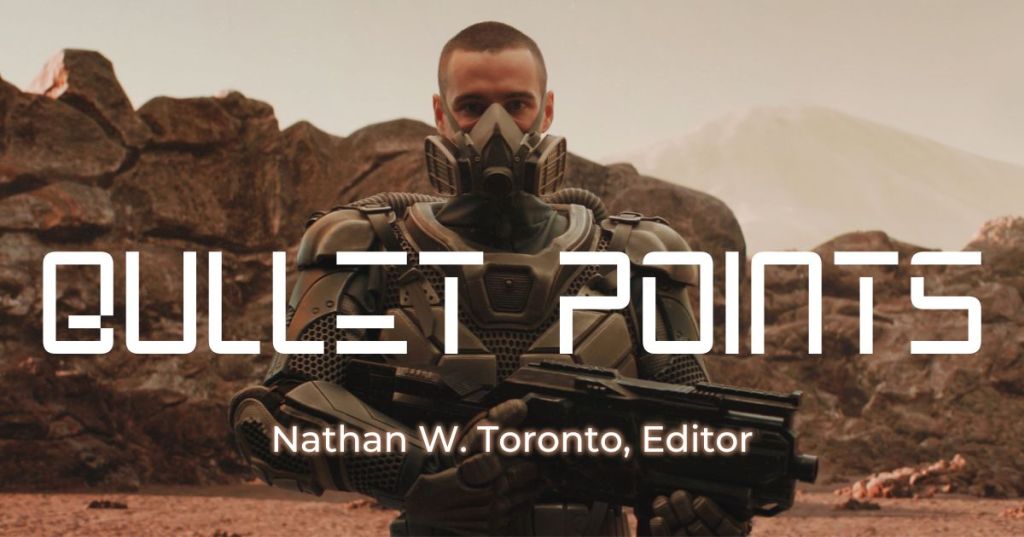
In this article, I’m going to be having a conversation with Nathan W. Toronto, the editor of Bullet Points Magazine. This is a magazine that publishes Speculative Military Fiction, Science Fiction & Fantasy, and Anti-War Military Science Fiction.
WHAT IS SPECULATIVE MILITARY FICTION?
Jessica: First, I wanted to ask: How do you define speculative military fiction, and what sets it apart from other speculative genres?
Nathan: Bullet Points hews to a broad definition of speculative military fiction. Most people focus on combat or tactical considerations to define the subgenre, but for Bullet Points, “military” fiction encompasses stories that explore some aspect of the organization or management of violence. Usually, war or warfare are pivotal to the setting or story. The story can revolve around someone who is affected by war or warfare and who is not actively participating in it, or it can be set in war’s aftermath, but if there is no organized application of violence, then there is no story.
Likewise, the story could revolve around insurgents or other irregular forces, but this is a matter of relative scale, since even insurgents do not operate in a state of nature; they organize their operations to some extent. The question is how this organization and management of violence matters. Being “military” doesn’t mean there has to be spit and polish, but it does mean we need to learn something new about war.
The beautiful thing about this subgenre is that it allows us to ask, given conditions that we don’t or can’t observe in our world, what would humans do in that most terrible human activity, war? There’s something powerful for me in this type of thought experiment.
Jessica: For anyone who is new to the genre, what books, stories, shows, or video games would you recommend?
Nathan: I’m not much of a gamer, at least not outside strategy board games like Risk and Axis & Allies, but there are three books that anyone new to the genre should start with: Orson Scott Card’s Ender’s Game, Robert Heinlein’s Starship Troopers, and Joe Haldeman’s The Forever War. These three books are foundational and offer different ideas about the organization of violence in society, be it through training and small group leadership (Ender’s Game), nationalistic propaganda (Starship Troopers), or isolating purveyors of violence from civilians (The Forever War). These novels go well beyond these themes, but together they paint a rich canvas for the dynamics of organizing violence for war.
These are the traditional starting point, but I wouldn’t stop there. Heinlein’s The Moon Is a Harsh Mistress, Frank Herbert’s Dune, the Star Wars movie Rogue One, and the Andor series explore the political, psychological, and institutional dynamics of rebellion. Understanding rebellion and insurgency is at least as important as understanding how a highly institutionalized military force operates. Weapons, destruction, and blowing things up are still a source of excitement in insurgent stories, but the subtle and not-so-subtle differences between the organization of formal military forces versus informal or irregular forces tell us a great deal about ourselves and offer plenty of avenues for building compelling stories.
I believe that the definition of speculative military fiction should be broader than the conventional wisdom currently dictates, but it’s also about more than violence in society generally. Murder mysteries and spy thrillers are not military simply because people get hurt. Military discipline and training matter for what we expect military forces to do, and it behooves authors to demonstrate that they know why these military institutions matter. The point is that speculative military fiction can appeal to a broader demographic than it currently does while maintaining its roots in a genuine understanding of that most terrible human institution, war.
Jessica: What role does speculative military fiction play in reflecting or shaping public discourse about veterans and modern warfare? What are some concepts that you believe are important for the public to understand about these topics?
Nathan: The traditional publishing industry has pigeon-holed speculative military fiction such that it can’t shape public discourse about veterans and modern warfare in a meaningful way. The Washington Post bestseller list rarely has science fiction or fantasy titles and almost never has speculative military titles (and none in the last year). This is one reason I started Bullet Points, to expand the reach of this wonderful, powerful subgenre.
The potential of the subgenre is massive. We have had a volunteer military force for fifty years in the United States. By now, too many lifelong civilians do not really understand the military experience. I never served, but I see how critical this civil-military connection is. We need stories to help us understand the post-traumatic stress, homelessness, and substance abuse that ravage those who fight our wars. Too many of us don’t understand the human costs of war. Too many of us don’t understand the effects of war on those on the home front, or those who are refugees or displaced because of it. If speculative military fiction can enlighten us in some way about these critical societal issues, then it will have done some good.
In the 1920s, Erich Maria Remarque’s All Quiet on the Western Front was pivotal in changing the way the public understood and viewed war. Total war, with entire societies mobilized for violence, has gradually receded in prominence over the last hundred years. Wars are still vile and deadly, but the scope and scale of destruction has decreased. More and more people around the world work to lessen the terrible effects of war and to reduce the political viability of war. Ultimately, speculative military fiction can help make war less deadly and less likely.
Jessica: Are there any trends you’ve noticed in speculative military fiction that are influencing what readers want?
I see two main trends. First, military technology is changing dramatically. Innovations in drones, hypersonic missiles, electronic warfare, information technology, and artificial intelligence are changing the battlefield. In Ukraine, for example, it is a lot harder for combatants to hide on the battlefield than it used to be, making it easier to find, fix, and destroy targets. The so-called “storm of steel” is no longer the most lethal aspect of the battlefield. Mobilizing soldiers for war and justifying violence politically has changed in the information age.
Readers are much more nuanced today than they used to be because of these changes, so speculative military fiction authors need to adapt in response. Second, interest in speculative military fiction is expanding significantly beyond the traditional core demographic of those who played with army men and read military history when they were boys. I am in this core demographic and I’ve seen a larger number of women and those who think about war differently demonstrate interest in the subgenre. I am pleasantly surprised by the diversity of stories that I find in the Bullet Points slush pile. This suggests that the subgenre is on the cusp of dramatically increasing its reach.
BULLET POINTS MAGAZINE:
Jessica: Can you share the origin story of Bullet Points magazine? What inspired its focus on speculative military fiction?
For years I submitted my work to traditional science fiction outlets. I was starting to develop a bit of an inferiority complex, but I knew I wasn’t that bad of a writer. I looked high and low but couldn’t find outlets for my short military science fiction, so I started asking around for stories and published the first annual anthology in 2021, with only seven stories. Over time, the pipeline grew and 2024 was the first year with quarterly issues. While the website has evolved over time, becoming more of a database and less of a blog, I have created print issues from the beginning. I’ve learned a LOT about this process, from using Canva to create covers and LaTeX to typeset interiors to navigating Kindle Direct Publishing and IngramSpark. I’m still pretty bad at marketing, but I’m here, right?
I feel like authors and readers are inspired by the mission of Bullet Points, which is to build appreciation for the military experience through short speculative military fiction. I’ve always been a war geek, reading military history and playing with GI Joes from a young age. I earned a PhD in international relations and wrote my dissertation on how militaries become professional, a critically important trend in human history. I have taught military operations and strategic decision-making to dozens of military officers over the years and I wrote an academic book called How Militaries Learn. When I was in grad school, I read Ender’s Game, which sucked me irretrievably into space. I’ve been a military science fiction addict ever since. I’ve written three military science fiction novels but still work full-time in a field I’m passionate about. Frankly, I have to work pretty hard to support my writing addiction.
Jessica: What themes or perspectives are you most interested in showcasing in the magazine?
Stories in Bullet Points must have both a speculative and a military element. Military fiction stories that do not have a speculative element? No dice. Science fiction stories without a military element? Nope. Stories that appear in this magazine must have both, and they must do it well. Bullet Points commits to being thoughtful: stories must teach us something about war. If prospective authors are in doubt about what this means, they can read a few of the 61 stories in the Bullet Points database (which has over 100 stories) that are open-access. I received 147 submissions last year and accepted 27; the most common reason for a story being rejected was that it lacked either a military or a speculative element (and sometimes both), so I clarified in the annual report what “military” and “speculative” mean for Bullet Points.
By far the most important characteristic of stories in Bullet Points is that they say something novel about war or warfare. “War,” in this case, refers to violent political struggle (why we fight) and “warfare” to tactical or operational considerations (how we fight). This is a pretty broad range of human activity for authors to work with, and in my mind, this could include the effects of war on civilians and the role of military members in combat support or rear echelon roles.
Jessica: Are there any standout pieces or authors in the magazine’s history that you feel represent its vision?
Do you have kids? That’s like asking me who my favorite children are. I love all the stories in Bullet Points. That said, there are a few stories that stick with me long after having read them, mostly because they are brutally honest about the complexity of the human condition at war. These are listed below with bullet points (of course) and in alphabetical order by author last name:
- Tony Ballantyne, “The War Artist” —Brian Garlick carries an easel into battle.
- Daniel Elliot, “Contract Killer” —Asher Dowd deals with mercenary customer service.
- Eric Fomley, “Bag of Soldiers” —A soldier collects memories of the dead on Ghede Prime.
- Joe Haldeman, “Time Piece” —A forever war across relativistic distances threatens humanity. (This story eventually became the seminal novel The Forever War.)
- Lena Ng, “The Night We Saw the Stars” —A mother, haunted by an alien invasion, brings hope to her child.
- Lisa Short, “Inversion Point”—The mission depends on an engineer with a hangover.
- George Tomkyns Chesney, “The Battle of Dorking”—An 1870s Englishman fights a Prussian invasion. (As far as I can tell, this is the first speculative military fiction story ever written.)
- Garth Upshaw, “Retaliatory Strike Force”—Karl comes to terms with what combat has done to him.
- Caias Ward, “Artist Known”—A parent remembers a child lost to an alien invasion.
Jessica: Thank you for taking the time to answer my questions and give such in-depth, thoughtful answers! That was all very informative. The most impactful sentence in this interview for me was, “Too many of us don’t understand the human costs of war.” I think that’s very true. It’s interesting to consider the ways in which military fiction could change the public consciousness about war and promote peace.
Readers, if you enjoyed this interview and want to read some military fiction, check out Bullet Points Magazine here! Also, subscribe to enjoy and support the genre.


 Stories From Tomorrow - Jessica Brook's Author Site