World Building Science Fiction – Venus


WHY COLONIZE A HOT BALL OF ACID?


Until the 1960s, Venus was thought to be a potential location for human colonies and space exploration because it was known that there were clouds on Venus, so there was some speculation that it could have an environment that was similar to Earth. Indeed early pulp science fiction (particularly between the 1930s-1950s) depicted Venus as a lush paradise full of jungles, oceans, swampland, Amazonian warrior women, and even dinosaurs.

It was only in the 1960s, when scientists got a better look, that it was discovered that Venus was super hot and that the clouds are made out of sulfuric acid.

Another problem is that Venus has more volcanoes than any planet in the solar system.

Currently now, much of the discussion of finding another planet for humans to live on focuses on Mars, not Venus. Yet surprisingly, there are many aspects of Venus that could make it a better candidate than Mars, despite Venus being a boiling hot oven of sulfuric acid. So some people are now saying that the original assumption popular before the 1960s was correct. One of the people who has argued that Venus is a better candidate for human colonization than Mars is Geoffrey A. Landis, a NASA researcher who has written much on this topic.

The benefits of Venus are its mass is 82% of Earth’s, and its surface gravity is 90% of Earth’s.

Because of the thick atmosphere, people wouldn’t need a heavy pressure suit, just a simple acid-resistant suit.

Mars, by contrast, has low atmospheric pressure, low temperatures, low gravity, and high exposure to cosmic radiation.

(Image source for picture above.)


BLIMP CITIES IN THE CLOUDS

(Image Source)

People would not be able to live on the surface of Venus (at least not in its current form). The surface is 900 degrees Fahrenheit (475 degrees Celsius), which means it is hot enough to boil lead.

However, the higher up you get from the surface, the thinner and cooler the atmosphere gets. There’s a sweet spot about 50-55 kilometers up where the atmosphere is down to about normal Earth pressure, and temperatures are similar to the Mediterranean.

As Geoffrey A. Landis says, the surface is hell, but at cloud level, it’s paradise.

So a possibility is to build floating cities 50-55 kilometers above the ground. But how would one do this?

Venus’s atmosphere may be a vital asset in this endeavor. Venus has an incredibly thick atmosphere, about 100 times that of Earth. Most of the atmosphere is carbon dioxide, with just over 3% being nitrogen, and only trace amounts of other gases. And yet Venus has more nitrogen than Earth, simply because it has so much atmosphere.

There is also a sea of carbon dioxide down on the surface, having characteristics of both a liquid and a gas, which will be important for terraforming the planet, but we’ll get to that later.

Now with regards to the carbon dioxide atmosphere, we must keep in mind that carbon dioxide has a molecular weight of 44, which means that any gas with a lower molecular weight than carbon dioxide can act as a lifting gas, much like helium in balloons on Earth. That means that hydrogen and helium work even better as a lifting gas on Venus than on Earth, but it also means that our normal oxygen-nitrogen air mix could actually make a balloon float on Venus. And you can get hydrogen, oxygen and water out of the sulfuric acid that makes up the clouds.

A near-term option for humanity would be to have automated aerostat vehicles in the atmosphere.

But for longer-term habitation, Venus’s colonists could make large, sturdy blimps with the mass manufacture of graphene. What is graphene you may ask? Graphene is the building block of graphite (which is currently used in pencils). This wonder material graphene is the thinnest material known to man, at one atom thick. And yet it is incredibly strong, 200 times stronger than steel. Graphene is also an excellent conductor of heat, electricity and has interesting light absorption properties. Graphene is an exciting material that is getting a lot of attention—especially since the 2010 Nobel prize in physics went to Andre Geim and Konstantin Novoselov, who first isolated Graphene in 2004.

And there is plenty of carbon for making graphene in Venus’s atmosphere. Venus’s colonists could use the carbon to make diamond hard tethers anchoring their blimp cities to the ground. These hard tethers could be possibly strong enough to survive the super-hot, acidic hurricane below. Or the colonists could use them like harpoons with a winch to drag their settlements around like a giant octopus.

Another benefit of Venus, Geoffrey A. Landis points out, is that the super thick atmosphere could provide shielding from cosmic radiation.


FLOATING SOLAR PUNK CITIES

(Image Source)

Up higher in Venus’s atmosphere, the lighting is a lot like Earth, except that if one stays in the same spot, they’ll have a day-night cycle not of 24 hours but of 243 days. Since the day-night terminator creeps along at a fast walking pace, even at the equator, a colonist could opt to stay in perpetual sunlight, making it handy for solar power or growing plants to help recycle air and water, and to extend food supplies.

In fact, solar arrays can produce just as much energy pointing downward toward the reflective clouds as they can produce by pointing toward the sun.

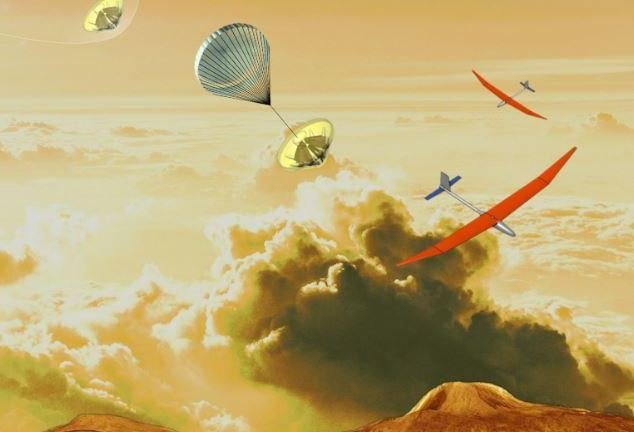
There is also a superabundance of solar energy to power engines. And all the wind allows colonists to use wings to provide lift for a plane or a kite, not just balloons and buoyancy. So, there are a lot of options for transportation and moving around in the clouds.

The abundance of atmospheric carbon dioxide and nitrogen will also be a useful resource for greenhouses.

The creation of mining robots could allow people in these sky cities to have autonomous sources of production that could give them a good deal of free time for recreation, education, family life, and spiritual reflection.

(Image Source)

Venus also has a surface area 3.1 times the land area of Earth. With all this room, a billion habitats, each one with a population of hundreds of humans, could be placed in Venus’s atmosphere.


OBSTACLES WITH FLOATING CITIES
(Image Source)

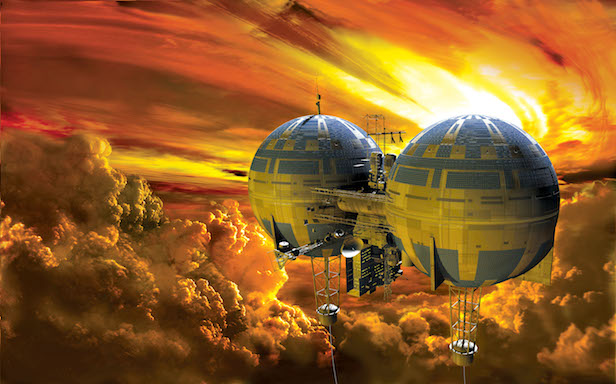
Floating cities would have their obstacles. Floating cities on Venus would have to be very thin and very lightweight to float. The colonists could also just orbit the planet in conventional rotating habitats. Yet being lower in the atmosphere would protect from meteors and radiation. Geoffrey A. Landis says the thick atmosphere would protect from radiation. But if this is not enough, the colonists could also put their blimps in water shielding to add some protection.


ROBOTIC MINING OF THE SURFACE

(Image Source)

Venus’s surface is way too hot for humans to mine on their own. But they could control mining robots from up in their floating habitats and deliver the goods by going up a tether in the form of a high-temperature fullerine tether. Or the robots could pop compressed gas cartridges to fill balloons and float back up.

A settlement could float over a spot they are mining.


TERRAFORMING VENUS

Terraforming Venus is another option. And given Venus’s mass and gravity, it may be the best candidate for terraforming in the solar system.

Terraforming could be accomplished by constructing a dome or an enclosure on the planet, which would grow to encompass most of the planet’s usable area. This could be part of the process of cooling down Venus.

Changing the Atmosphere:

(Image Source)

Part of the reason Venus is so hot is its thick atmosphere. But a major reason for the heat is Venus’s proximity to the sun. If one blocks out the light between Venus and the sun, they could reduce that heat. Colonists could use massive shades that are about as big as a football field but don’t weigh too much. Ideally, they would want to use something very light and strong, like graphene made of carbon. The colonists could manufacture these graphene shades on the cloud cities of Venus and deploy them to the Lagrange point between the sun and Venus by the millions until they shade Venus’s atmosphere. The atmosphere would then begin to cool. The thick atmosphere would start to liquefy and turn into seas of carbon dioxide.

The floating cities would probably not survive the process of liquefying the atmosphere, so the colonists would have to abandon them and retreat to orbital colonies. Or they could modify the floating cities to safely survive the process (like some Johnny Quest car blimp?) and be able to land on the seas of carbon dioxide and survive the changeover of early terraforming. During cooling, there would be a ton of earthquakes and maybe volcanic activity while it snows dry ice. And then, the colonists would have to find a way to export or permanently sequester all that carbon dioxide so they could warm the planet to an Earth-like temperature and an atmospheric composition.

Another possibility for clearing the atmosphere of Venus would be to use solar mirrors instead of shades. This would heat the planet even more and evaporate the atmosphere away.

But if the colonists went with the strategy of cooling the planet, they could keep cooling it until the seas of carbon dioxide froze and turned into surfaces of dry ice. Then they could pave over that and introduce dirt and water.

The trouble is, how to get enough water for oceans?

There is a large amount of water available in Venus’s atmosphere. But it isn’t enough for real oceans. It’s enough for people to drink and to farm food inside greenhouses. But it’s not enough to make a classic biosphere. For that, the colonists would need to come up with somewhere between 10-100 billion megatons of hydrogen.

One possibility is to boil hydrogen off the sun since the sun is a massive source of hydrogen.

Another possibility is to import the hydrogen from Jupiter or Saturn.

However, when it comes to making Venus more Earth-like, there is also the problem with Venus’s day length. Venus’s day is longer than its year. The sun would rise in the sky and stay there for months before setting for more months.

There are three approaches to this:

First, ignore it and adapt to life on a planet like this.

Second, place mirrors in orbit around Venus to bounce light down on the night side and block incoming sunlight on the day side to simulate a 24-hour day cycle.

Thirdly, the colonists could also make a fake sun with lots of mirrors to bounce light to something about the same angular size in the sky as the sun in Earth’s sky. All the mirrors and shades could also protect Venus from radiation. Though colonists would still want to consider an artificial magnetosphere to hold the atmosphere in. They can’t expect the atmosphere to stick around on its own once they make Venus earth-like.

The other alternative is to go all in and adjust Venus’s rotational speed to a 24-hour day, or maybe save some energy and let people sleep in longer with a 26-hour day. Yet the colonists would need massive amounts of energy to change the rotation of a planet. They would need 10^29 joules of rotational energy to do this. To put that in perspective, it’s more than a billion times the amount of electricity 21st century Earth uses each year. It’s also only a few years of energy output from the sun. (Though it would take roughly the same amount of energy to ship in enough hydrogen to create an ocean.)

Accomplishing this task could come in the form of sending a large beam of hydrogen from the sun like a water jet, hitting one side of the planet Venus, injecting hydrogen and spin. If we were getting the hydrogen from gas giants instead, each of those ships and pods would be moving quite fast, carrying a large amount of kinetic energy. The amount of kinetic energy needed for massive transports of hydrogen would be in the same ballpark as rotational energy. So the colonists would need to figure out how much hydrogen they want and how much rotational energy they need and make sure each pod of hydrogen is moving at a speed to deliver that energy. If that were moving too fast, they might ship in comets or massive balls of ice and let the extra mass carry the extra kinetic energy. It would still be very tricky to get this process to work. But a benefit of this is that if the planet is spinning fast enough, it could generate a magnetosphere, so the colonists wouldn’t have to generate an artificial one.

Another possibility is to give Venus a moon and use it as a gravity tractor to impart spin. And the outer planets of our solar system have an abundance of moons, along with excess hydrogen. The colonists could also take the excess carbon from Venus and build a fake moon.

While these are all interesting ideas, the reality is that terraforming Venus would most likely take thousands of years. So this would involve a long-term commitment that would outlast the length of many civilizations. The kind of society willing to do this would either have to be very dedicated, or they might be some form of artificial intelligence with a lengthy lifespan.

The residents of Venus have a few options: The orbital colony route, the floating city route, the para-terraforming route where they use shades to cool the planet down and use orbital mirrors to create a 24-hour day, or go big and start spinning the planet up to a 24-hour day by importing shipments of hydrogen or water to impart that spin momentum.

The colonists also don’t only have to do one option. They could have several phases or multiple options pursued simultaneously.


WHAT WOULD THE VENUSIAN ECONOMY LOOK LIKE?
(Image Source)

Carbon in the form of graphene will likely be the preferred building material of the future, so Venus could export gigatons of that.

For export, Venus has lots of carbon dioxide, nitrogen, and solar or wind energy for industrial processes. They could also build solar-powered satellites for export, along with shades and mirrors for terraforming.

Mining the surface (which is primarily a basaltic silicate), will provide silicon, iron, aluminum, magnesium, calcium, potassium, and sodium.

Venus could give Mars pods of nitrogen for their terraforming process, which could get shipped to their atmosphere and shot down. Metal for the pods would come from mining the surface of Venus.

Venus is closer to Earth than Mars. With current propulsion systems, launch windows to Venus occur every 584 days, compared to the 780 days for Mars. Flight time is also somewhat shorter; the Venus Express probe that arrived at Venus in April 2006 spent slightly over five months en route, compared to nearly six months for Mars Express. This is because at closest approach, Venus is 40 million km (25 million mi) from Earth (approximated by perihelion of Earth minus aphelion of Venus) compared to 55 million km (34 million mi) for Mars (approximated by perihelion of Mars minus aphelion of Earth) making Venus the closest planet to Earth.

Then there is the accessibility of asteroids from Venus. In terms of flight time, Venus is closer to the Asteroid Belt than either Earth or Mars. Geoffrey A. Landis argues that the higher orbital velocity of Venus makes transfer orbits somewhat faster and increases the number of transfer opportunities to various asteroids in the Asteroid Belt.

There is also the possibility of tourism on Venus. The appeal is that people can walk around beautiful sky cities without a heavy pressure suit. And with the thick atmosphere, there is the possibility of hang gliding with just a mask and a thin acid proof suit.


EXAMPLES OF VENUS IN EARLY SCIENCE FICTION

(Image Source)

As mentioned at the top of this article, Venus was a popular planet in early science fiction before it was known that the surface was hot enough to melt lead. Therefore, there are quite a few examples of humans colonizing Venus, especially in the age of early pulp Science Fiction. But be aware that these examples do not offer accuracy given what we know about Venus today. I mean…especially not with the dinosaurs and Amazonian warriors and so on.

In the early pulp science fiction of the mid twentieth century, there was a lack of agreed upon canon about what Venus was like, given that the stories about life on the planet included everything from thick jungles, to a water world covered in oceans, to widespread deserts. In comparison, the writing about Mars was much more uniform.

Science fiction scholar Gary Westfahl attributes the disparity largely to the image of Mars made popular by Percival Lowell around the beginning of the 20th century. By contrast, very little was known of Venus aside from the fact it had clouds.

Disclaimer: I produced a list below of examples of Venus in science fiction. This list below doesn’t represent all instances of Venus in science fiction, as there are multiple instances. The list simply represents a few examples I have chosen to highlight.

Venus in Fiction (Wikipedia)

A True Story by Lucian of Samosata – 2nd Century A.D. (One of the earliest known examples of interplanetary travel in fiction. Lucian refers to Venus as the ‘morning star.’)

Voyage à Vénus by Achille Eyraud 1865 (One of the earliest known uses of Venus as the primary setting in fiction)

Last And First Men by Olaf Stapledon -1930 (A book that discusses genetic engineering for interplanetary colonization.)

“The Big Rain” by Poul Anderson – 1954 (Anderson writes about terraforming Venus’s atmosphere.)

In the Walls of Eryx by H. P. Lovecraft – 1936

Perelandra by C. S. Lewis – 1943 (This is a retelling of the story of Adam and Eve in the Garden of Eden on floating islands in a vast Venusian ocean.)

Lucky Starr and the Oceans of Venus by Isaac Asimov – 1954 (Asimov depicts human colonists living in underwater cities on Venus.)

“Before Eden” by Arthur C. Clarke – 1961 (Clarke portrays Venus as mostly hot and dry, but with a habitable climate at the poles.)


VENUS IN MODERN SCIENCE FICTION

(Image Source)

2312 by Kim Stanley Robinson – 2012 (A very well written novel showing human colonization on multiple worlds in our solar system.)

The Sultan of the Clouds” by Geoffrey A. Landis in Asimov Magazine – 2011 (I highly recommend this story for anyone who wants a more scientifically sound depiction of what life on Venus could look like. This is written by a NASA researcher.)

The Snows of Venus by G. David Nordley in Analog magazine – 1991 (In this story, G. David Nordley suggests that Venus might be spun-up to a day-length of 30 Earth days by exporting its atmosphere of Venus via mass drivers.


ART

Venus Science Fiction Art on Pinterest


LEARN MORE ABOUT COLONIZING VENUS

(Image Source)

Colonizing Venus Video by Isaac Arthur (YouTube)

Colonization of Venus by Geoffrey A. Landis (NASA, February 2003)

How to colonize Venus, and why it’s a better plan than Mars (Big Think, 11-28-18)

How Could We Create Settlements on Venus? (Universe Today, 9-4-16)


RELATED PAGES

World Building Science Fiction – Mercury (Stories From Tomorrow)

Why Good Stories Still Get Rejected – Fusion Fragment Magazine

Writing is a field where you can do everything right and still (most likely) get rejected. Even having a well written character, setting, and plot is not always enough.

Many writers are aware of why bad stories get rejected: grammatical errors, boring, cliche, weak passive language, confusing plot, too much or too little description.

But why does a good story get rejected?

The Sci-fi magazine, Fusion Fragment, has a really helpful twitter thread on this topic.

I’ll summarize their reasons here:

  • Not a good fit for the particular publication: This is the “It’s not you, it’s me,” of publishing. But it is true. Someone can submit a really well written story that just doesn’t fit in to a particular publication, whether due to style, tone, humor, or other reasons. That’s why it’s a good idea to familiarize yourself with the style of a particular publication before you submit your work.
  • Controversial Content: There are certain topics that some publishers are hesitant to handle. This can include suicide, bigotry, sexual assault, etc. If you are writing about a touchy subject, proceed with caution. Certain publishers are edgier than others. So if you want to be edgy, do your research.
  • Topic Frequency: You may have written an excellent story about alien abduction, for example. But the problem is that the magazine may have already accepted a bunch of stories on this topic and is looking for something else. This is why it’s a good idea to study what particular publishers are looking for, or what they would like more of. Also be aware of what topics have been done so much that editors are sick of reading about them. As far as I am aware, zombies, vampires, and young adult dystopia can be a hard sell for this reason.

Aside from the reasons Fusion Fragment gave, I’ll also add a few of my own.

  • Luck: Luck unfortunately is a component of publishing. It’s not everything, but it is a factor. And this factor is out of your control (unless you have a magical lamp somewhere).
  • Timing: Your submission may have arrived at a time when perhaps the editor wasn’t in the best mood, or doesn’t like your topic because of something else they recently read that left a sour taste in their mouth. Who knows? But much like luck, you can’t control this.

I hope this was helpful for you. Remember. You can’t control the outcome of who publishes your work. But you can commit to the process. If you commit to getting better and submitting content on a regular basis, you will increase your chances of success.

If you have any comments on this topic, feel free to leave them here.

Links

Fusion Fragment Magazine

What I Learned in Dan Brown’s Masterclass (Stories From Tomorrow)

Color Coding Rejection (Stories From Tomorrow)

Seven SMART Writing Goals for 2023

(Image Source)

As the new year approaches, it’s a good time for writers to revisit their goals.

Writers.com has some good advice on how to set smart, reliable, achievable goals. They use the acronym SMART.

SMART is all about the properties of a good (“smart”) goal.

It stands for:

Specific. Make your goal or objective as specific as possible. Say exactly what you want to achieve in clear, concise words.

Measurable. Include a unit of measurement in your goal. Be objective rather than subjective. When will your goal be achieved? How will you know it has been achieved?

Achievable. Be realistic. Ensure that your goal is feasible in terms of the resources available to you.

Relevant. Your goals should align with your values and long-term objectives.

Time-bound. Give yourself a deadline within a year. Include a time frame such as a week, month or year, and include a specific date if possible.

Here are seven goals I can think of that match this acronym.

  • I will finish my outline for my work in progress by (insert date)
  • I will set aside (insert amount of time) to write each day, for at least 5 days a week.
  • I will finish my work in progress by (insert date)
  • I will join a critique group and commit to it (insert number) times a month.
  • I will submit my work to (insert number) of publications each month.
  • I will read for (insert amount of time) a day.
  • I will share my content on social media (insert number of times) a week.

You will notice I did not write things like. “I will finish my work in progress.” Or. “I will get published.” Or “I will write 12,000 words a day.” The best way to accomplish a goal is to make it specific, realistic, to create firm deadlines, and to break it down into small achievable pieces.

Committing to the process is also more important than making “getting published” a goal. There’s no way to know for certain that you will get published, but instead it’s better to make the goal something like, “I will submit to 2 publications a month,” because that is something you know you can achieve.

I added a social media component, because an important aspect of writing in today’s world is having followers who are interested in your work.

I also added reading and critique groups because these things help you to get better as a writer.

Check out this article on writers.com for more information.

#PitDark is Today!

“#PitDark is the first and only Twitter pitch event to highlight literature of a “darker” nature. Importantly, this is not limited to horror works; however, any pitched manuscript must contain an element of horror or darker writing. Examples of such categories include pure horror novels, dark fantasy, murder mysteries, psychological horror stories, non-fiction works about darker subjects, etc. MG, YA, NA, and adult age categories are welcome.”

See More Details Here

Why “The Love Interest” Is a Boring Character

Do I hate love? Am I cold, dark hearted person?

Or is it that the “love interest” is a boring character in fiction? Specifically, the “Satellite Love Interest” trope is a character who exists solely in reference to another character as a cherished love object. In fact, the “Satellite Love Interest” could often be replaced with a bag of flavor blasted goldfish and the plot wouldn’t be affected much. This is similar to the sexy lamp test.

A satellite character is one whose sole purpose revolves around another more interesting, more significant character.

Does this mean that I am saying romance shouldn’t be a part of fiction? Absolutely not. What I am saying is that a character is more interesting if they are well developed and complex in their own right, and don’t depend on another character for their relevance.

EXAMPLES OF SATELLITE LOVE INTERESTS:

[Spoilers Included. If I list something you haven’t watched/read yet, feel free to skip past to avoid spoilers.]

[Disclaimer: The critique of the characters in the live action shows and movies mentioned is not a critique of the actors who play these characters. I’m sure these actors are all fine people.]

The Prince from Snow White:

This dude shows up at the beginning of the film to be all pretty and charming. That’s about it. Then he disappears for most of the film and returns at the opportune moment to wake Snow White up from her poison apple induced food coma. Rumor has it that Prince Charming had a larger role originally, but the animators were struggling with animating a human male.

Bella Swan from Twilight:

Bella Swan is a unusual example of the Satellite Love Interest being the main character of her own story. We don’t learn much about what her life was like before she moved away from sunny Arizona to rainy, emo Washington state: a place full of foggy montages and sparkly forests that echo with the sounds of early 2000s indie rock. That’s because all that matters is Edward, the most handsome vampire who ever handsomely handsomed into existence.

Bella easily makes friends at the beginning of the novel (because everyone loves her for inexplicable reasons), but then she dumps them all to be with the only person in the universe who matters—Eddie Pants. Her entire life soon revolves around Edward, to the point where she goes catatonic when he leaves her. She jumps between being Edward or Jacob’s satellite love interest throughout the series. Edward and Jacob could easily have been fighting over a bag of flavor blasted goldfish, because Bella had that special blood that made her a delicious snack.

Luke Bankole from The Handmaid’s Tale TV Show

Luke Bankole is the husband of the main character, Offred. He escapes Gilead and makes it to Canada. There he pretty much exists to pine for Offred, to be in her flashbacks, and to flail around (like one of those car dealership blowing floppy guys) in multiple attempts to be helpful that don’t end up panning out.

When Shows Try to Keep An Unnecessary Love Interest Character…

Laurel Lance/Black Canary from the show, Arrow:

In Arrow, we see Oliver Queen pining for Laurel while he’s stuck on the island (he’s stuck so long on that island). However, in season 3, the show writers make a sudden, and unexpected shift to the “Olicity” track, where they ship Oliver away from Laurel to the quirky, perky, blonde and nerdy Felicity Smoak. Many people believe that this was fan service, as fans found Felicity more interesting than Laurel.

After shipping Felicity with Oliver, it seemed the show writers didn’t have much they could do with the character of Laurel/Black Canary, since her original purpose was to be a love interest. So they kept finding contrived reasons to keep her relevant, including having Laurel die but then come back as an evil version of herself from another universe (I’m not even making this up).

However, I will say, some fans grew to like Black Canary in later seasons as the writers attempted to develop her into a more complex character. I stopped watching by season 6 because the show writers kept turning everyone Oliver met into a superhero. That boy had a superhero STI that affected everyone he touched, but that’s a story for another post.

Iris West Allen from the show, The Flash:

If you look on Reddit and Quora, there’s a lot of people who were not a fan of Iris West Allen, the love interest of Barry Allen/The Flash. In a show full of super heroes and super geniuses, Iris West Allen doesn’t really seem like she has a reason to be there. What makes her special? She writes an online blog?

Some people might say a character can still be interesting even without super powers and super intellect. And that is true for her father, Joe West. He’s likeable in the sense that he has life wisdom, street smarts and a sense of humor that dissolves tension. But unfortunately for Iris West Allen, she’s not even likeable.

Her catchphrase, “We are the Flash,” is cringey and reeks of entitlement. She routinely insists that she’s always right (when she happens to be in a room full of geniuses with super powers and multiple PHDs). Many people believe the writers put her into the position of authority over Team Flash simply because they had nothing else to do with her.

EXAMPLES OF INTERESTING LOVE INTERESTS:

I don’t want to be only negative, so I’ll try to point out some interesting love interests as well. I think the reason why the following love interests below work is because they are an integral part of the story, and couldn’t easily be replaced with a bag of flavor blasted goldfish.

MJ (played by Zendaya) in MCU’s Spiderman

MJ overall received positive reviews as a a strong, supporting character. She’s smart, snarky and interesting whenever she’s on the screen. She also helps Peter, Ned and Doctor Strange capture multiple super villains. She’s intelligent enough to feel like an organic part of the team (she is a soon to be student at MIT after all) and she has personality quirks that make her unique and yet sympathetic. She struggles with disappointment, and often avoids getting excited or happy about things so she won’t end up disappointed. I think many people can relate to that (myself included). And importantly, she is likeable!

All of the Love Interests in the show, Ms. Marvel

Ms. Marvel has received overwhelmingly positive reviews so far. It is a light-hearted, fun show about a teenage, Muslim, Pakistani super hero. She actually has multiple love interests in the show (which seems normal for a teenage girl).

First, there’s her loyal, nerdy sidekick Bruno. While Bruno obviously has feelings for Kamala Khan, she is oblivious to his attractions. This is a tale as old as time. Bruno is stuck knee deep into the friendzone. But he still tries to help her when he can with his technological innovations and moral support.

Then enters the tall, dark and handsome Kamran as the new kid at school. Kamala immediately becomes interested in him (why wouldn’t she?). He’s even willing to offer her driving lessons, which is a plus. But soon it becomes clear that he’s giving her attention because he wants her to help his mom, who happens to be a jinn. I think more than being handsome, he has an interesting background story and ends up being likeable. He takes a moral stand against his jinn mother, who is trying to make a portal that could destroy life on Earth.

The next potential love interest we meet is Kareem, a masked fighter who is a legacy crime fighter associated with The Red Dagger. So far he seems mysterious, and I definitely want to learn more about Kareem as the show progresses.

Mike in Stranger Things

Mike is Eleven’s love interest in Stranger Things. Yet more than being a guy she pines for, he is “the heart” of the team as Will states in a platonic (but not so platonic) speech about Mike in Season 4.

Mike is likeable as a loyal friend and a loyal boyfriend. He experiences some doubts about himself from time to time, but ultimately pulls through at the end of the day to help his friends.

Links

Sexy Lamp Test

Satellite Love Interest (TV Tropes)

SFWA: Tired Disability Tropes In SFF – Do Better

The Science Fiction and Fantasy Writers Association recently released an article about tired disability tropes. It’s a great resource for those who want to include disabled characters in their stories.

Why write about disabled characters? For for the same reason you would include any other character, because disabled people are a part of the world. Their experiences, their stories, and their representation matters.

However, there are many times people write about a disabled character who has a gift so powerful that their disability is functionally erased and they might as well not even be disabled at all. 

Read the SFWA article here for more information

Why I Won’t Rush The First Draft of My Next Novel

One of the conventional pieces of wisdom fiction writers hear is, “Write a quick and dirty first draft. You can always fix it later!” As someone who has been writing fiction since 2014, I have heard this advice a lot from both professionals and amateurs. It’s practically canon, up there with, “Show. Don’t Tell.”

I myself have cranked out a first draft for a 120,000 word cyberpunk novel in a mere two months. Many people use the month of November for this very purpose.

Now some people swear by this model. It may work great for many folks. But it doesn’t work great for everyone. For me, writing a first draft is like laying concrete for a sidewalk. Once the concrete dries, it’s difficult to go back and repave it later. A story evolves naturally from character motivations. If key components of your characters’ motivations have to be changed later, then you are going to have to do massive rewrites of the plot itself, practically writing a new book. It’s like building a road to one location and then discovering you are going to have to build a whole new road because the location has been changed.

And apparently I am not the only one who thinks this way. There are several other writing sites out there that explain the pitfalls of rushing a first draft, which I will link to at the end of this article.

Rushing a first draft may work very well if you are a planner. If you have all the key plot points, scenes, and character motivations written down in an outline or in your notes, then rushing the first draft itself could work very well for you. Things like setting and the choreography of action in a fight scene can always be improved upon later. However, if you are like me, and write things by the seat of your pants, you may end up with a manuscript that takes way too long to revise because you didn’t think through key story components beforehand. Much like building a house with faulty components, and then having to build over the weak material–which is often harder than just building a whole new house from scratch.

Things you should think about before you write your manuscript:

  • Main characters and their motivations.
  • What makes your characters likeable? What do they struggle with? Why should people want to read about them?
  • What is the arc of the characters?
  • What is the key conflict of the story?
  • What is the premise of the story?
  • Key plot points. “Tent pole scenes.”
  • Genre and conventions of the genre.
  • Research key components of world building.

Problems that can happen with rushing:

  • The rewrite process takes much longer than it should.
  • You may end up rushing your book to publishers before it’s ready.
  • You may lose interest and end up working on something else. If you wrote something that takes so much time to fix that you basically have to write a whole new novel on top of it, you may just prefer to write a whole new novel instead.
  • You have something that is fundamentally not marketable.

Anyways, that’s why I’m not going to rush my next first draft until I have key components of the story thought through. This will be difficult for me, because the writing process itself is what is fun for me, and not the planning process. But I think if I can force myself to do a little more planning beforehand next time, it will pay off in the long run.

And also, it’s OKAY to write something that doesn’t sell or get published. Ultimately doing something is better than not doing it at all. Perfection is the enemy of the good. However, as we evolve in our craft, we should also work at getting better with the planning process as well.

Why Fast First Drafts Aren’t for Everyone (The Write Practice)

3 Ways to Avoid Rushing Your Book (Writing Cooperative)

5 Pitfalls of Rushing Your First Draft (Script Wrecked)

Top 10 Books on Writing

Below are the top ten books from Best Books on Writing – Recommendations from 36 articles, Barack Obama, Bill Gates, Elon Musk and 53 others. (Read This Twice).

TOP TEN BOOKS ON WRITING

(Sorted by most recommended)

On Writing by Stephen King

Bird by Bird by Anne Lamott

The Elements of Style by William Strunk Jr.

The War of Art by Steven Pressfield

On Writing Well by William Zinsser

Save The Cat! The Last Book on Screenwriting You’ll Ever Need by Blake Snyder

Story by Robert McKee

The Artist’s Way by Julia Cameron

Writing the Breakout Novel by Donald Maass

Plot & Structure by James Scott Bell

RELATED LINKS

Best Books on Writing – Recommendations from 36 articles, Barack Obama, Bill Gates, Elon Musk and 53 others. (Read This Twice)

Reddit Thread on Top 100 Books

How to Get A Literary Agent – Gen Con Online Panel 2020

This year Gen  Con went online. As a result, they had a lot of great online FREE panels. Including many great resources for writers. I myself went to the “How to Get an Agent” panel that starred Lucienne Diver (Agent with The Knight Agency) Maurice Broaddus (Fantasy and Horror Author), Toni L. Kelner (Mystery Author), E.C. Ambrose (Fantasy and other genres author), Chris Bell (Panel Host and Managing Editor for Indie Press)

I took some notes about the most critical things mentioned in this panel.

This came from How to Get an Agent Panel Live (On YouTube)


Why Should You Get an Agent? 

Why not just wing it on your own?

Toni L. Kelner replied, “For the big bucks. For the money.” It was further explained that an agent can help your book get into a bookstore, into an international book store. Agents know what’s selling and how to market your work.

E.C.Ambrose added that agents are also important for understanding contracts.

Maurice Broaddus added on to this by saying he first realized he needed an agent when he got a 14-page contract and needed someone who could decipher it.


What Do Agents Do? 

Lucienne Diver made the point that many people are not aware of what an agent actually does. A big part of their role is career planning. Especially for people who want to become career authors and aren’t just treating their craft as a hobby. An agent can figure out which is the best line to launch an author’s particular work. So it’s not just about the agent getting the writer money, it’s about the agent figuring out what the best position is for the writer. It’s about trajectory. “We are career managers as much as we are negotiators and contract managers…agents wear many hats (Lucienne Diver).”


How Does Someone Just Starting Out Get an Agent? 

Social Networking: Lucienne Diver explained that writers conferences are a great resource because you are meeting people there. You are networking. Maurice Broaddus confirmed this by saying he met his agent by wearing “a very loud red suit” at the bar.

Writers Organizations: Another useful tool for getting an agent are professional writers organizations. These often have a list of agents who are reputable in that field. Such as Science Fiction Writers of America. The Association of Authors Representatives. Etc. Not all agents will necessarily be members of these associations. 

Do Your Research and Follow Guidelines: Lucienne Diver explained that it’s very important to follow an agent’s submission guidelines. Don’t try to be clever or cute. Agents have a whole mountain of slush in their inboxes every week. An easy way for agents to reduce the slush pile is to ignore the submissions that don’t follow the rules.


Warnings About Bad Agents

One point made in the panel is that agents are only human. So sometimes they make mistakes. Sometimes they are not doing the best job representing your work. Sometimes they are experiencing a mid life crisis.

Maurice Broaddus talked about an agent he had who was not reading his stuff or sending it out in a timely manner. What good was she doing for his career if she wasn’t even reading his stuff?

E.C.Ambrose said it is worse to have a bad agent than no agent, because you think your agent is doing their job but they’re not.

Aside from the writer’s panel, I myself made friends with a writer on Twitter who said she did get a book published, but the sales were abysmal because the agent didn’t do the best job representing her. Her agent had a lot of stuff going on in her life and took about two years to even get this author representation. This author I know was writing vampire romance. In the year she wrote the book, vampire romance was hot. But by the time it got into the bookstores, the genre was passé. 

So long story short, if your agent is not communicating with you in a timely manner, it’s best for your career to find alternative representation.

Absolute Write has a good “Writers Beware” section. 


How to Obtain an Agent Through a Query Letter?

A query letter is a letter an author sends to a prospective agent to get that agent interested in their book.

E.C.Ambrose went into detail about what a query letter is.

Keep in mind that agents are readers first, so you want to get them excited about reading your book. You want to show them you’re capable of hooking a reader’s attention and writing something that has a beginning, middle, and end.

A query letter should answer the following questions:

  • Why are you approaching this particular agent (what is it about them that would make them a good fit for your work)?
  • What is the concept of this book?
  • How does it fit into the marketplace?
  • How is it different than the marketplace (How is it unique)?
  • Who is the main character?
  • What is the conflict?
  • What is the setting?

Example: “In 14th century England, a barber surgeon discovers he has the magic of death.” This tells you a lot about the book in one sentence.

The end of the query should explain more about you as a writer:

  • Who are you as a writer?
  • Have you gotten anything published?
  • Have you attended any workshops?
  • MFA?

ONLY Send Out a Query if Your Manuscript is COMPLETE

Lucienne Diver even said “make it a fifth draft at least.” Get multiple eyes on your work. Get beta readers. Get lots of feedback. Revise based on feedback. Provide the most polished version of your work you can provide.


Will Self Publishing Hurt Your Chances of Getting an Agent? 

This is the one million dollar question. A question I wonder a lot about myself, and that I have heard asked multiple times before.

Lucienne Diver said that there is no one path to getting published. She’s had authors who started out self-published. She also has hybrid authors. However, her biggest piece of advice is that if you are going to self-publish, make sure you do a professional job of it, because what you do leaves a track record. Get a pro to edit your work. Get a pro to make your cover. If an agent sees that you self published something full of typos that gets bad reviews, they’ll think you’re not ready to be a professional author.

LINKS

How to Get an Agent Panel Live (On YouTube)

Gen Con Writers Panel Collection (On YouTube)

Gen Con Online 2020

Lucienne Diver (Agent with The Knight Agency)

Maurice Broaddus (Fantasy and Horror Author)

Toni L. Kelner (Mystery Author)

E.C. Ambrose (Fantasy and other genres author)

Chris Bell (Panel Host and Managing Editor for Indie Press)